
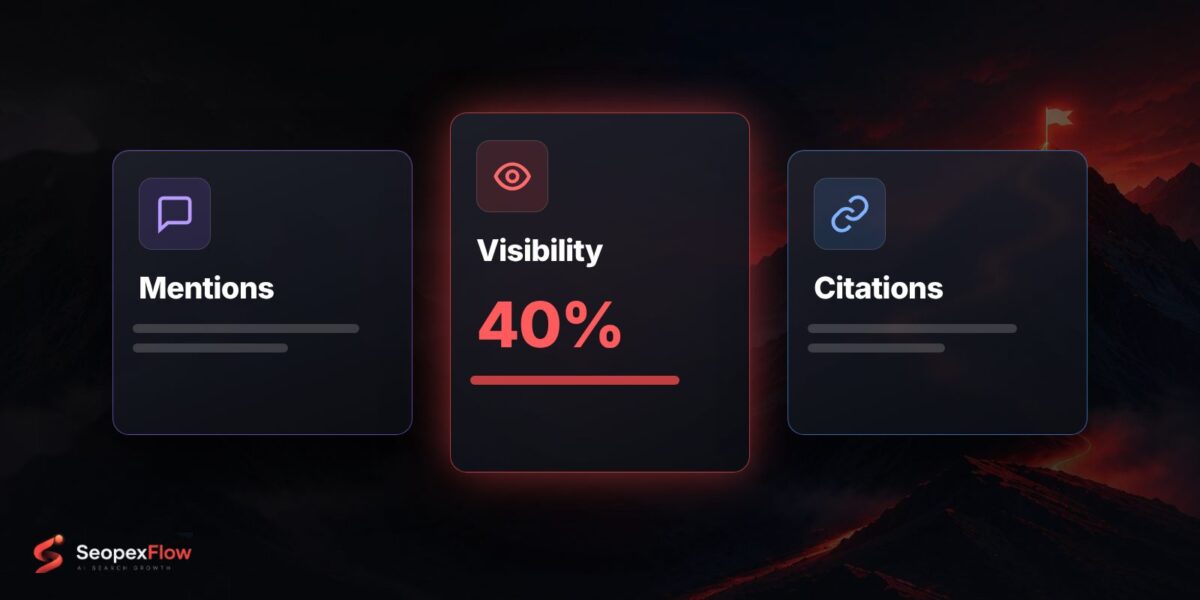
AI Mentions, AI Citations and AI Visibility are often used as if they meant the same thing. They do not — and mixing them up leads to wrong conclusions and wrong priorities. This guide defines each metric, shows how they relate, explains how to calculate them, and describes what to do when one is strong and another is weak.
In one sentence each
AI Mention: your brand is named in the answer. AI Citation: your page is linked as a source. AI Visibility: the share of the questions you track where you appear at all.
What is an AI Mention?
An AI Mention happens when your brand name appears in the text of an AI-generated answer — in a list of recommendations, a comparison, an example, or a description. A mention can come from live sources the system retrieved, or from what the model learned during training.
Not all mentions are equal. Record the context of each one:
- Recommended — the answer suggests your brand as a good choice.
- Listed — your brand appears among options without a clear recommendation.
- Compared — your brand is weighed against others, positively or not.
- Inaccurate or negative — the answer contains wrong information or criticism.
What is an AI Citation?
An AI Citation happens when the platform shows one of your pages as a source — a link, a source card, or a footnote. Citations depend heavily on retrieval: your page must be accessible, indexed by the search system the platform uses, and useful for answering part of the question.
Citations matter for two reasons: they are a trust signal (the system relied on your content), and they are the main path to clicks from AI answers. Track which URLs are cited — often it is not the page you expected.
What is AI Visibility?
AI Visibility is an aggregate metric: the percentage of your tracked questions in which your brand appears, through a mention, a citation, or both, during a period.
AI Visibility = questions where you appear ÷ total tracked questions × 100
Because AI answers vary, a more robust version counts appearances across repeated runs: if each question is asked several times, divide the runs where you appear by the total runs. Always report visibility per platform and per language, as well as overall.
How the three metrics relate to each other
| Situation | What it usually means | Priority action |
|---|---|---|
| Mentioned and cited | Strong position: known and trusted as a source | Protect accuracy; expand to more questions |
| Mentioned, not cited | The model knows your brand, but your pages are not the best source | Make your pages clearer and more specific |
| Cited, not mentioned | Your content is used, but your brand is not credited in the text | Make brand and product names explicit in the content |
| Neither | Not part of the answer for this question | Check access, content gaps and external evidence |
Illustrative example (sample data)
A SaaS company tracks 50 questions on two platforms. Its brand is mentioned in 18 answers, its pages are cited in 7, and it appears in some form in 20 questions — an AI Visibility of 40%. The gap between mentions (18) and citations (7) suggests the brand is known, but its documentation and comparison pages are not the sources being chosen.
How each metric is measured in practice
- Define the question set — grouped by intent and product line. See our measurement guide.
- Run questions under fixed conditions — platform, mode, language, clean session.
- Record mentions — present or not, position, and context.
- Record citations — the exact URLs shown as sources, including competitors’.
- Calculate visibility — per platform, per language, per intent group, and overall.
- Compare over time and with competitors, using the same set of questions.
Which metric matters most for your goals?
- Brand awareness and consideration — focus on AI Mentions in category and comparison questions, and on how you are described.
- Traffic and leads — focus on AI Citations, and on which landing pages are cited.
- Market share and reporting — focus on AI Visibility versus competitors, by platform and intent.
- Reputation — monitor inaccurate or negative mentions in brand questions.
How to improve each metric
Improving AI Mentions
- Keep brand facts consistent across your site, profiles and listings.
- Earn independent coverage: reviews, partner pages, comparisons, expert articles.
- Be clearly positioned: state who you serve and what you are best at.
Improving AI Citations
- Make sure the right pages are crawlable and indexed.
- Answer specific questions directly, with facts, tables and FAQs.
- Create the definitive page for each important topic instead of several overlapping ones.
Improving AI Visibility
- Prioritize the questions where competitors appear and you do not.
- Cover both Arabic and English questions where you serve both audiences.
- Track platforms separately; improvements on one do not automatically transfer to others.
For the full method, read What is GEO?.
Common mistakes when reporting these metrics
- Treating a mention as a citation, or the opposite.
- Reporting one screenshot instead of a rate across repeated runs.
- Changing the question set between periods and calling the difference growth.
- Ignoring context — an inaccurate mention is not a win.
- Mixing platforms and languages in a single number without the breakdown.
See all three metrics for your brand
SeopexFlow measures AI Visibility, AI Mentions and AI Citations across five AI platforms, with competitor comparison and trends. Request a free analysis.
Frequently asked questions
Is a citation always better than a mention?
Not always. A citation is more likely to bring clicks, but a strong recommendation in the answer text can influence a decision even without a click. Track both.
Can I be cited without being mentioned?
Yes. A platform may use your page to answer part of a question while naming other brands in the text. That usually means your content is useful but your brand is not prominent within it.
Why do my numbers differ between platforms?
Each platform uses different retrieval systems, sources and models. Differences are normal, which is why visibility should always be reported per platform.
