
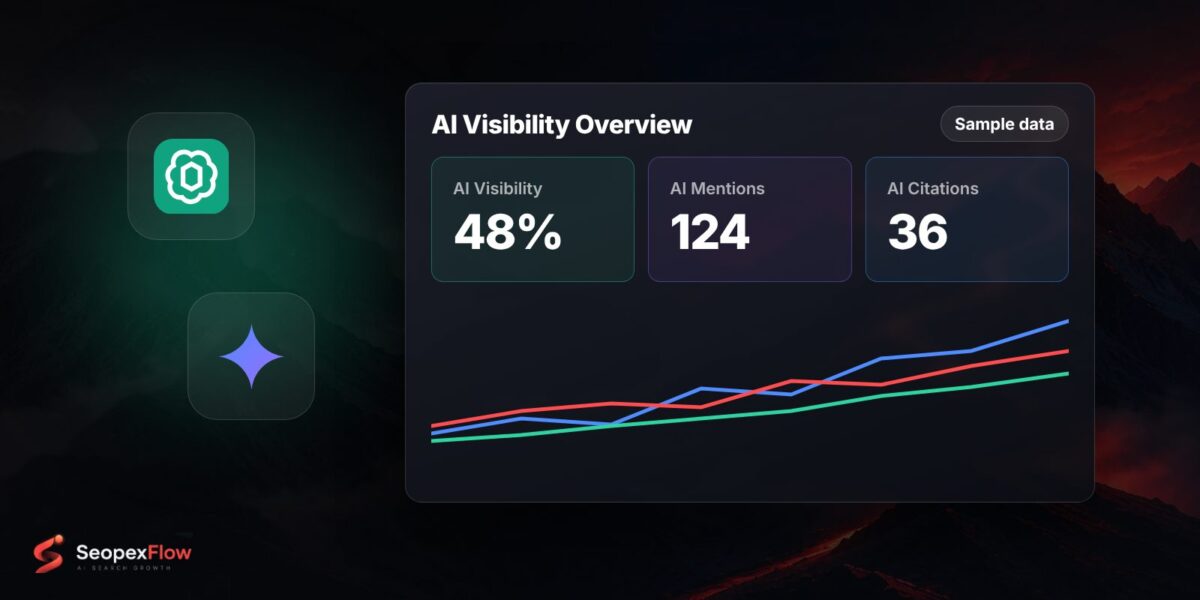
“Are we showing up in ChatGPT?” is now a common question in marketing meetings — and a single screenshot is the usual answer. This guide replaces the screenshot with a repeatable method: choose the right questions, test them consistently, record mentions and sources, compare yourself with competitors, and turn the results into a regular report that leads to action.
What you need to know
AI answers change with wording, time, location, language and conversation history. You cannot measure them with one check. You measure them like a survey: the same questions, asked the same way, repeated over time.
What does measuring AI Visibility mean?
Measuring AI Visibility means tracking how present your brand is in AI-generated answers for the questions that matter to your business. It answers four practical questions:
- For which of our important questions do we appear at all?
- How are we described — recommended, compared, or only listed?
- Which of our pages are used as sources?
- Who appears when we do not?
The difference between AI Mentions, AI Citations and AI Visibility
| Metric | What it counts | Example |
|---|---|---|
| AI Mentions | Your brand name appears in the answer text | “Popular options include Store A and Store B.” |
| AI Citations | One of your pages is shown as a source link | A source card linking to your product page |
| AI Visibility | The share of tracked questions where you appear (mention or citation) | You appear in 12 of 40 tracked questions = 30% |
These are explained in depth in AI Mentions vs AI Citations vs AI Visibility.
How to choose the questions worth monitoring
Your question set is the foundation of every number you report. Build it carefully:
- Start from revenue. List your main products, services and customer segments.
- Collect real questions from sales calls, support tickets, reviews, site search and Search Console queries.
- Write them as people ask an assistant — full sentences, including context such as city, budget or use case.
- Include both languages when you serve Arabic and English speakers; they often produce different answers.
- Keep the set stable. Add new questions in batches and keep a version history, so trends stay comparable.
A practical starting size is 30 to 100 questions; enough to show patterns, small enough to review manually at first.
How to classify questions by user intent
| Intent | Example question | Why it matters |
|---|---|---|
| Category / discovery | “What are the best project management tools for small teams?” | Shapes the shortlist |
| Comparison | “Brand A vs Brand B for agencies?” | Close to a decision |
| Problem | “How do I stop customers abandoning checkout?” | Early demand you can educate |
| Local / transactional | “Where can I buy an air purifier in Dubai with fast delivery?” | Direct sales intent |
| Brand | “Is Brand A reliable?” | Reputation and accuracy |
Report visibility by intent group. Appearing for brand questions but not for category questions is a very different situation from the opposite.
How to test your brand’s visibility in ChatGPT and Gemini
- Use clean sessions — log out, or use a fresh profile or temporary chat, to reduce personalization and memory effects.
- Fix the conditions — record the platform, mode (for example web search on or off), language and, where relevant, location.
- Ask each question exactly as written, with no follow-ups, so runs are comparable.
- Repeat — run each question more than once per period; a brand that appears in some runs but not others is “unstable”, which is useful information.
- Save evidence — keep the answer text and the date for every run.
Practical tip
Apply the same protocol to Google AI Overviews, Claude and Perplexity. Different platforms often recommend different brands for the same question, so a single-platform view can be misleading.
How to record the sources and links mentioned
For every run, log at least these fields:
- Date, platform, mode and language
- Question and intent group
- Brand mentioned? (yes/no) and position in the answer
- How it is described (recommended, neutral, negative, inaccurate)
- Cited URLs — yours and others
- Competitors mentioned
Over time, the list of cited domains shows which publishers, marketplaces and review sites shape answers in your category — valuable targets for partnerships and PR.
How to compare your visibility with competitors
Track three to five direct competitors on the same question set. Useful comparisons include:
- Share of visibility — the percentage of questions where each brand appears.
- Head-to-head gaps — questions where a competitor appears and you do not.
- Source overlap — which sites cite competitors but not you.
Illustrative example (sample data)
An electronics store tracks 40 questions. It appears in 12 (30%), its main competitor in 22 (55%). The gap is concentrated in comparison questions about headphones, where the competitor’s buying guide is cited repeatedly. The next action is clear: publish a better comparison guide and improve the related product pages.
How to build a recurring measurement dashboard
- Cadence — weekly for fast-moving categories, monthly for most businesses.
- Headline view — AI Visibility per platform and per language, with the trend.
- Breakdowns — by intent group, product line and competitor.
- Sources — your most-cited pages and the external domains cited most in your category.
- Accuracy log — any incorrect statements about your brand, with the date found and the fix applied.
A spreadsheet is enough to start. As the question set grows, a dedicated tool saves time and keeps the method consistent.
How to handle changing answers and inconsistent results
- Look at rates, not single answers. “Appeared in 3 of 5 runs” is more honest than “appeared”.
- Annotate changes — platform updates, new content you published, campaigns — so you can explain movements.
- Separate noise from trend — wait for a change to persist across several periods before acting on it.
- Never present one screenshot as proof of success or failure.
How to connect measurement to improvement opportunities
- Not mentioned, competitor mentioned → create or improve the page that should answer the question; earn third-party coverage.
- Mentioned, not cited → make your page the clearest, most specific source on that topic.
- Cited, but described inaccurately → correct and clarify facts on your site and external profiles.
- Unstable presence → strengthen consistency and evidence across sources.
Combine this with the foundations in our GEO guide.
Skip the manual work
SeopexFlow runs your questions across five AI platforms, records mentions, citations and competitors, and shows the trend over time. Start with a free analysis.
Frequently asked questions
Can I see how many people saw my brand in ChatGPT?
No. AI platforms do not provide impression data the way Search Console does. That is why visibility is measured by sampling a representative set of questions.
Can I track AI traffic in analytics?
Partly. Some visits from AI platforms carry a recognizable referrer, so you can segment them in your analytics tool. Many AI-influenced visits, however, arrive later as direct or branded-search visits.
How many questions do I need?
Start with 30–100 well-chosen questions covering your main products and intents. Quality and stability of the set matter more than size.
