
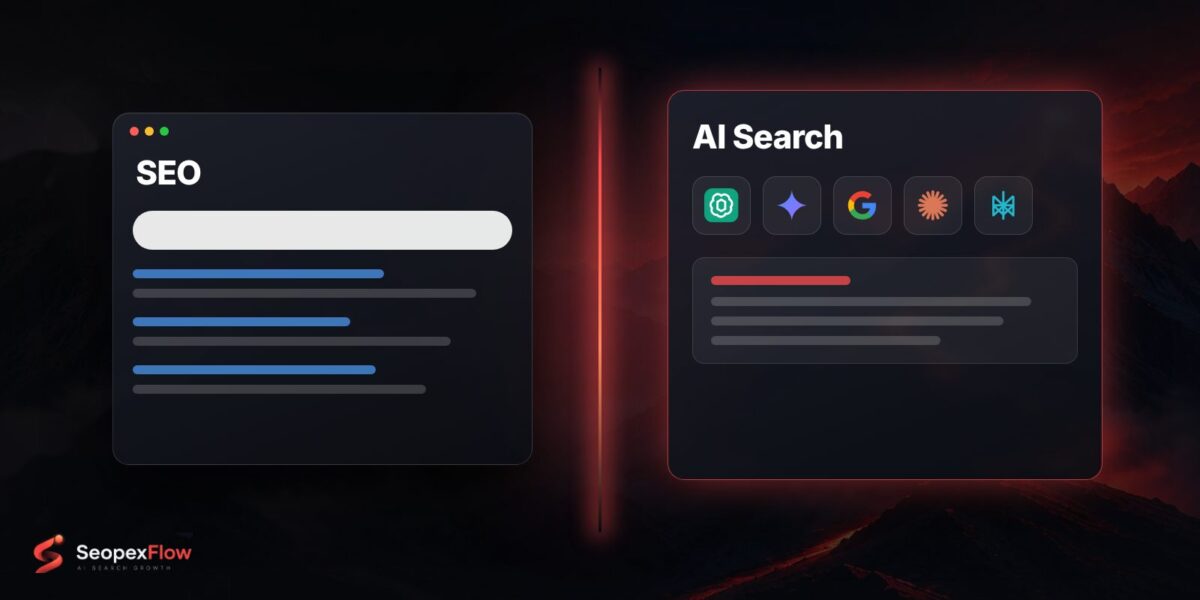
People no longer discover brands only through a list of ten blue links. More and more searches end in a written answer — in Google AI Overviews, ChatGPT, Gemini, Claude or Perplexity — that summarizes options, compares them and sometimes names a few brands. This guide explains what AI Search is, how it differs from traditional SEO, what stays the same, and how to start improving your visibility without confusing visibility with traffic.
In short
AI Search does not replace SEO. It builds on it. Pages that are crawlable, indexed, clear and genuinely useful remain the foundation; AI Search adds a new layer where you also need to be understood, trusted and mentioned inside the answer itself.
What is AI Search?
AI Search is any search experience where a generative AI system answers the question directly instead of — or alongside — showing a ranked list of pages. The system reads the question, retrieves relevant information, and writes an answer in natural language. Depending on the platform, the answer may include links to the sources it used.
Today the main AI Search surfaces are:
- Google AI Overviews and AI Mode — AI-generated summaries inside Google Search, with supporting links.
- ChatGPT — conversational answers, with web search for recent or specific information.
- Gemini — Google’s assistant, which can ground answers in Google Search.
- Perplexity — an answer engine built around cited sources.
- Claude — Anthropic’s assistant, which can search the web when it needs current information.
How does traditional search work?
Classic search engines follow three broad steps: they crawl pages, index them, and rank indexed pages for each query. The user receives a results page and decides which link to open. Your job in traditional SEO is to make pages easy to crawl and index, match them to what people search for, and earn enough relevance and trust to rank.
The unit of success is the click: a visitor lands on your page, and everything else — engagement, leads, sales — happens on your site.
How do AI-powered search systems work?
Most AI Search systems combine a large language model with a retrieval step. This pattern is often called retrieval-augmented generation (RAG):
- Understanding the question — the system interprets intent and may split one question into several related searches.
- Retrieval — it pulls candidate passages from a search index or the live web.
- Selection — it keeps the passages that best answer each part of the question.
- Generation — the model writes one answer, combining what it retrieved with what it already learned during training.
- Attribution — on many platforms, it shows links to some of the sources it used.
Two consequences matter for brands. First, the model can mention your brand from what it learned in training, even without linking to you. Second, when it retrieves live sources, your pages must be accessible, indexable and easy to quote to be considered at all.
The difference between SEO and AI Search
| Aspect | Traditional SEO | AI Search |
|---|---|---|
| What the user sees | A ranked list of pages | A written answer, sometimes with sources |
| Typical query | Short keywords | Full questions, comparisons and follow-ups |
| Unit of success | Ranking position and clicks | Being mentioned, recommended or cited inside the answer |
| What is evaluated | Whole pages | Passages, facts and entities that can be combined into an answer |
| Competition | Ten or more results per page | Often only a few brands named per answer |
| Consistency | Relatively stable rankings | Answers vary by platform, wording, time and user context |
| Main metrics | Rankings, impressions, CTR, traffic | AI Visibility, AI Mentions, AI Citations, competitor share |
Illustrative example — two search journeys
Traditional journey: a shopper searches “wireless headphones Riyadh”, opens three stores from the results, compares prices and buys. AI journey: the same shopper asks “Which wireless headphones are best for long calls, and where can I buy them in Riyadh?” and receives a short list of models and two or three stores. If your store is not in that list, you were never part of the comparison.
What role do retrieval, sources and citations play?
When an AI system searches the web before answering, it behaves a lot like a careful researcher with limited time. It favors sources that:
- are accessible to its crawler and indexed by the search system it relies on;
- answer the specific question clearly, near the top of a section;
- state facts precisely — names, specifications, prices, conditions, dates;
- are consistent with what other reputable sources say about the same topic or brand.
A citation means the platform shows your page as a source. A mention means your brand is named in the answer, with or without a link. They are different signals, and you should track them separately — see our guide to AI Mentions, Citations and Visibility.
Is SEO still important in the age of AI Search?
Yes — arguably more than before. Google states that the same foundational SEO best practices apply to its AI features: there are no additional technical requirements, and no special schema or “AI file” is needed to appear in AI Overviews or AI Mode. To be shown as a supporting link, a page must simply be indexed and eligible to appear in Search with a snippet.
Other platforms depend on their own crawlers and on search indexes. If your important pages are blocked, slow, thin or duplicated, they are less likely to be retrieved by any system. In practice:
- Technical SEO keeps your pages discoverable.
- Helpful, original content gives AI systems something worth quoting.
- Clear entity signals help models understand who you are and what you offer.
Practical tip
Do not stop investing in SEO to “do GEO” instead. Treat AI Search work as an extension of the same discipline: the same pages, made clearer, more specific and easier to cite.
How is search and buying behavior changing?
AI assistants change three things about how people research purchases:
- Longer, more specific questions. Users describe their situation (“for a small clinic”, “under 500 riyals”, “that ships to Kuwait”) instead of typing a short keyword.
- Comparison inside the answer. The shortlist is formed before the user visits any site, so being included matters more than ranking first.
- Fewer but better-informed visits. Some questions are fully answered without a click; the visitors who do click often arrive later in their decision.
For brands in Arab markets, there is an extra layer: questions are asked in Arabic, English and mixed language, and local details — cities, payment methods, delivery, regulations — strongly shape which brands are recommended.
How to start improving your site’s visibility
- List the questions that matter. Write down the questions your customers ask before buying — comparisons, “best for” questions, problems and objections — in both Arabic and English.
- Check how AI answers them today. Ask those questions on the main platforms and note which brands and sources appear.
- Fix the foundations. Make sure key pages are crawlable, indexed, fast and not blocked for the crawlers you want to allow.
- Answer clearly. Add direct answers, specifications, comparison tables and FAQs to the pages that should win those questions.
- Strengthen your entity. Keep your brand name, description and key facts consistent across your site, profiles and listings, and use accurate structured data.
- Earn independent mentions. Reviews, partner pages, press and expert content help models trust what you say about yourself.
Our AI Search readiness guide turns these steps into a full checklist.
How to measure results without confusing visibility with traffic
AI Search success does not always show up as more sessions in analytics. Measure it in layers:
- Visibility layer — how often your brand appears for a fixed set of tracked questions, on each platform.
- Source layer — how often your pages are cited, and which pages.
- Competitive layer — how your presence compares with your main competitors for the same questions.
- Business layer — referral traffic from AI platforms, branded search, leads and sales over time.
Because answers vary between runs, measure the same questions repeatedly and look at trends rather than single results. Our guide on how to measure your visibility in ChatGPT and Gemini explains a practical method.
Want to see where you stand?
SeopexFlow tracks your brand across five AI platforms and shows which questions you appear in, who appears instead of you, and what to fix first. Request a free analysis of your site.
Frequently asked questions
Will AI Search replace Google?
Not in a simple sense. Google itself now shows AI-generated answers, and people use several tools side by side. The practical question is not “Google or AI?” but whether your brand is visible wherever your customers ask.
Do I need a special file or schema to appear in AI answers?
Google says no special file or schema is required for its AI features. Accurate structured data that matches your visible content is still useful, because it makes your information easier to understand. Proposed files such as llms.txt are experimental and are not a confirmed ranking or citation factor on the major platforms.
Can I guarantee my brand will be recommended?
No. No one controls what an AI system writes. You can improve the likelihood by being accessible, clear, consistent and well referenced, and you can measure progress over time.
Is AI Search only relevant for large brands?
No. Specific, local and niche questions are often where smaller brands have the best chance, because few sources answer them well — especially in Arabic.
